
You already know diesel sits in tanks for months at a time. You know a generator that starts well in June can fail to start in January. The real question is whether a treatment belongs in that fuel, and what kind.
I wrote this to give you a clear answer. I looked at the problems that hurt stored diesel, the habits that cause them, and the products that address them. I chose my recommendations by asking three things. Does the product fit the problem? Does the company explain what the product does? Does it stay safe for modern engines?
By the end, you will know when a diesel fuel stabilizer makes sense, which problems it cannot fix, and how to build a simple routine for your generator or storage tank.
The Short Answer
If your diesel sits for more than a few months, I recommend treating it. If your generator runs only in emergencies, I recommend treating it every time you fill the tank.
If you burn through your fuel in a few weeks, you have less to worry about. Even then, a good conditioner protects your injectors and pump.
The longer fuel sits, the more chances water, microbes, and cold weather have to cause trouble.
What Goes Wrong With Stored Diesel
Diesel does not spoil as fast as gasoline, but it does change over time. Here are the main problems I see:
- Water in the tank. Moisture enters through vents and builds up from temperature swings. Water sits at the bottom and feeds the next problem.
- Algae and microbes. They need air, water, and warm temperatures to grow. They clog filters and leave sludge.
- Gelling in the cold. Wax in the fuel forms crystals as temperatures drop. Those crystals block filters and lines.
- Low lubricity. Ultra Low Sulfur Diesel has less natural lubrication than older fuel. Injectors and pumps depend on that lubrication.
- Deposits. Dirty fuel leaves buildup on injectors, which hurts spray patterns and power.
A stabilizer or conditioner cannot fix a tank that is already full of sludge. It works best when you start with clean fuel and a clean tank.
Generators: Standby or Daily Use
Standby generators
A standby unit may sit for months, then run during a storm. The fuel in that tank is old by the time you need it. Water and microbes have had time to settle in.
I suggest you treat the fuel when you fill the tank, run the unit under load on a schedule, and check the tank for water a few times a year.
Portable and job site generators
These units run more often, and you refill them often. Treatment still helps, mainly in cold weather. A small generator has a small filter, and small filters gel quickly. Treat your fuel before temperatures drop, and keep a rescue product on hand.
Storage Tanks: Bulk and Inground
If you keep hundreds or thousands of gallons on a farm or a job site, treatment is more important. A large tank collects water at the bottom, and a large volume of fuel can sit for a full season.
Treat the fuel as it goes in. Drain or remove water on a schedule. Keep the tank full when you can, because a full tank holds less air, and air feeds microbes. Keep caps and vents in good shape.
For bulk storage, you want a product made for large volumes. Dosing by the ounce does not work well on a 275 gallon tote.
Why I Recommend Howes Products
Howes Products is a family-owned company in North Kingstown, Rhode Island. They have made fuel additives and lubricants since 1920, and the fifth generation now runs the business. They say every product gets lab testing and field testing before release, and their formulas contain no alcohol or harmful solvents.
Here is why I point readers to them for generators and storage.
They handle water the right way
Howes Diesel Treat uses a petroleum-based formula that demulsifies water and pushes it out of the fuel. A water separator can then remove it. Some products mix water into the fuel instead. Howes notes that the demulsifying method is the one major diesel engine manufacturers prefer.
One product covers several needs
Diesel Treat works as an anti-gel and a conditioner. It adds lubricity, helps prevent injector deposits, and reduces cold filter plugging. The company says it is warranty safe, friendly to particulate filters, and effective in all diesel and biodiesel blends, including home heating oil.
The company also says overtreating with their diesel products does no harm. If you are unsure about the dose, that gives you some room.
They make products for large tanks
Diesel Treat Concentrate is built for bulk and inground storage. It uses a wax crystal modifier that changes the size and shape of wax crystals so they cannot bind and gel. It also adds lubricity, helps prevent deposits, and removes water. The ratio can be as strong as 1 gallon per 3,000 gallons above 0°F.
Diesel Defender Concentrate brings cleaning and lubricity to drums and totes. The company says one tote treats up to 825,000 gallons.
They back their products
Every Howes product carries a 100 percent satisfaction guarantee. The company also offers a Winter Tow Guarantee on Diesel Treat. A company that stands behind its product gives you less risk.
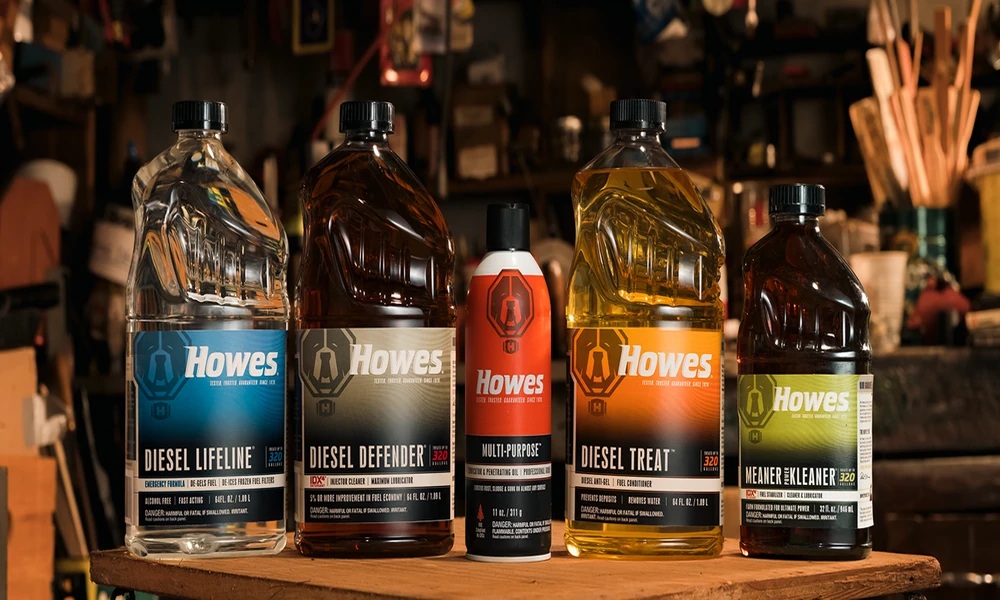
Matching a Howes Product to Your Situation
- Standby generator, cold climate: Diesel Treat at each fill. Above 0°F, the label dose for smaller bottles is 1 ounce per 5 gallons. Below 0°F, it is 1 ounce per 2.5 gallons.
- Generator with injector wear or dirty fuel: Diesel Defender, which has an IDX4 detergent to clean deposits and add lubricity.
- Bulk or inground tank: Diesel Treat Concentrate or Diesel Defender Concentrate, in drums or totes.
- Fuel that has already gelled: Diesel Lifeline. An anti-gel cannot reverse gelling after fuel passes its cloud point. Lifeline modifies the melting points of wax and ice crystals so fuel can flow again. The company says it works in about 15 minutes in many cases and needs no pre-mixing.
- Equipment with a neglected history: Meaner Power Kleaner, a one-tank deep clean for injectors and deposits.
Read the label on each product and follow the dose for your tank size and temperature. Howes products are made to work together, so you can use Diesel Treat and Diesel Defender in the same tank.
A Simple Routine I Recommend
1. Start with a clean tank and fresh fuel when you can.
2. Add your treatment as you fill, so it mixes with the fuel.
3. Keep the tank as full as you can during long storage.
4. Check for water at the bottom every few months and remove it.
5. Run standby generators under load on a regular schedule.
6. Treat again before winter, and keep a rescue product within reach.
Mistakes to Avoid
- Waiting until cold weather arrives to treat fuel that is already old.
- Adding treatment to a tank full of sludge and expecting it to clean everything.
- Ignoring water at the bottom of the tank.
- Using a product with alcohol or harsh solvents in your fuel system.
- Guessing the dose on a large tank.
My Recommendation
You need some form of fuel care if your diesel sits for months, and you need it more if your generator protects your home, farm, or business. The cost is small compared to a failed start or a clogged filter.
I recommend you look at Howes Products first. They give you a way to handle water, cold weather, lubricity, and deposits, in sizes from a small bottle to a 275 gallon tote. Choose the product that matches your tank, follow the label, and build the routine above.